
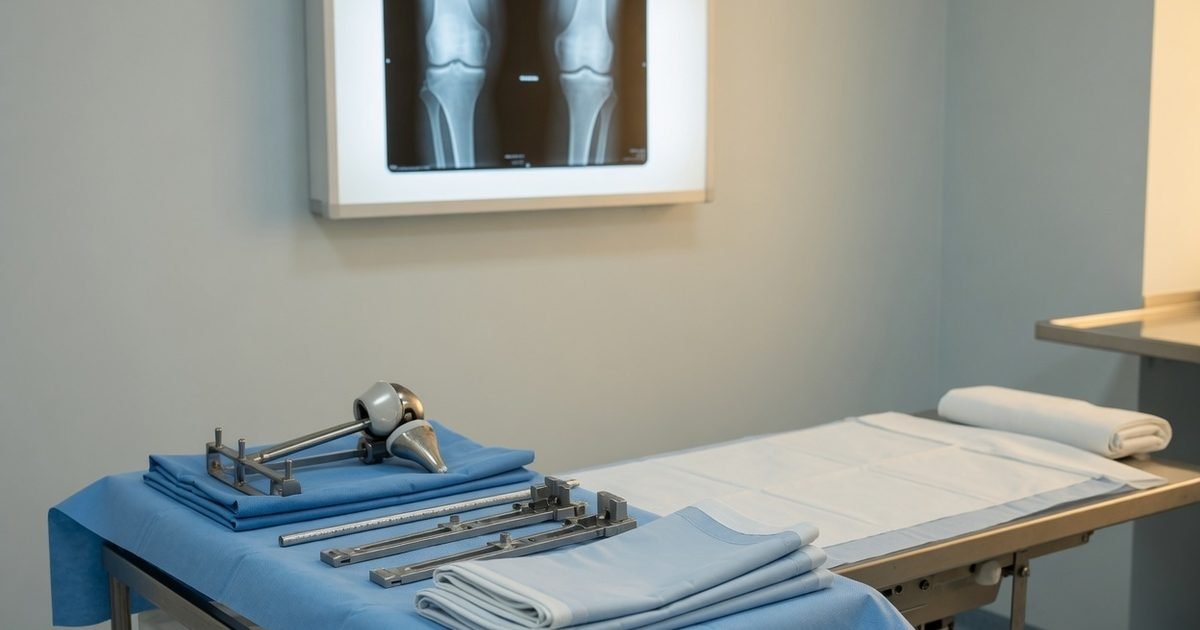
Knee replacement is one of the most common operations in this entire field of planned treatment abroad — and one of the easiest to compare badly, because the internet is full of single figures that answer no questions about your case. This article compares the published cost and access picture across India, the US, the UK and Australia, and is explicit about what each number assumes.
Cost is one axis of this decision. Whether a knee replacement is clinically right for you, and which implant and approach suit your knee, is a question for the orthopedic surgeon who has actually seen your X-rays. What follows is logistics and money, not clinical advice.
Knee replacement cost and access: the four countries at a glance
| Cost and access factor | INDIA | UNITED STATES | UNITED KINGDOM | AUSTRALIA |
|---|---|---|---|---|
| Knee replacement, published figure (single knee) | About $2,300–5,200 at tier-2 city private hospitals; $3,500–7,600 at metro private hospitals (rate-list ballparks) | 2018 employer-plan claims average for a knee-or-hip admission — a blended figure, not a single-knee price: $35,263 for an inpatient knee-or-hip replacement admission in large employer plans; area averages ranged from $25,044 (Baltimore) to $56,739 (New York City) | £14,341–£18,236 average private self-pay package by city (data collected March 2026) — roughly US$18,600–23,700 at mid-2026 rates | About A$23,200 typical for a private hospital patient — roughly US$15,300 at mid-2026 rates; the tool’s figures assume Medicare plus private insurance |
| What that figure covers | The surgical package: surgeon, anaesthetist, theatre, a named implant class, a fixed number of room nights | An average insurer-paid amount for the hospital admission, not a price list | Surgeon, anaesthetist and hospital fees; first consultation and some extras may sit outside | Typical specialist fees plus hospital fees bundled |
| Where the published figure comes from | Hospital rate-list ballparks; implant prices regulated by India’s NPPA price ceilings | Peterson-KFF Health System Tracker, employer-plan claims data | PHIN, the UK’s private healthcare information authority | The Australian Government’s Medical Costs Finder |
| Access route for an eligible resident | Private self-pay is the norm for planned surgery | Insurance (employer, ACA, Medicare) or self-pay | NHS via GP referral with the 18-week constitutional right; private self-pay alongside it | Public hospital via specialist referral with wait lists; private with insurance or self-pay |
| A self-pay visitor is priced how? | Published ballparks exist before travel; an itemized written quote replaces them | Cash prices vary by facility; many hospitals publish price-transparency files | Generally chargeable for planned hospital care as an overseas visitor; the private package averages are the visible numbers | Not covered by the tool’s assumptions; a local private quote is the only real number |
What does a knee replacement cost in India?
Our India knee replacement ballparks article carries the full detail. In summary: a single knee replacement is commonly quoted at about ₹2.0–4.5 lakh (roughly $2,300–5,200) at tier-2 city private hospitals and ₹3.0–6.5 lakh (roughly $3,500–7,600) at metro private hospitals, with same-admission bilateral surgery priced well below double. Two regulatory facts make these ranges more checkable than most: India’s pharmaceutical price regulator sets ceiling prices for knee implant systems (a primary cobalt-chromium femoral component is capped at ₹32,063.79 against ₹51,562.94 for coated titanium or oxidised zirconium — extended through November 2026), and the government employee scheme’s published rate list prices the implant components on their own lines by material, which is why a quote that does not name the implant is incomplete anywhere.
Two practical notes matter for the comparison. First, published Indian rate lists mean a ballpark is visible before you travel — and a written quote for your case replaces every range here. Second, tier-2 city hospitals (Indore, Jaipur, Coimbatore among them) often quote below metros for the same operation by similarly qualified surgeons; that gap reflects their cost structure, not a verdict on quality.
What does a knee replacement cost in the United States?
The most defensible published benchmark is the Peterson-KFF Health System Tracker, which analyzes employer-plan claims: the average inpatient admission for a full knee or hip replacement cost $35,263 in 2018, up 38% over the prior decade — and the geography swings are enormous, from a $25,044 average in the Baltimore area to $56,739 in the New York City area. Three cautions apply. It is an average amount paid by insurers for people covered by large employer plans — not a price list, and not what an uninsured patient would be quoted. Individual facility cash prices can land far from any average, in both directions. And for a self-pay visitor, the relevant number is a facility-specific cash quote, which US hospitals’ price-transparency files make possible but which takes work to assemble and compare.
For US residents weighing an out-of-pocket procedure, our article on when US insurance won’t cover surgery abroad covers the coverage questions to close first.
What does a knee replacement cost in the United Kingdom?
The UK has two systems, and the comparison must not blur them. The NHS route is free at the point of use for eligible residents: GP referral, consultant-led assessment, and the constitutional right to treatment within 18 weeks — our NHS knee replacement waiting times article carries the sourced RTT statistics, so no waiting figures are restated here. The private self-pay route has visible published prices: the Private Healthcare Information Network (the UK’s official private-healthcare information authority) publishes average self-pay knee packages of £14,341–£18,236 by city from data collected in March 2026, usually covering surgeon, anaesthetist and hospital fees, with the first consultation and some extras often priced separately.
Two UK-specific facts matter to a comparison. Paying privately does not cost a UK resident their NHS place — government guidance is explicit that entitlement to NHS services remains. And a person who is not ordinarily resident in the UK is generally chargeable for planned NHS hospital care under the overseas-visitors charging rules, so the published private package averages are the visible numbers for a visiting patient. Our UK private treatment vs NHS wait vs India article works through both routes.
What does a knee replacement cost in Australia?
The Australian Government’s Medical Costs Finder — the official tool for typical private-hospital costs — estimates a knee replacement at about A$23,200 in typical total costs (specialist fees plus hospital fees). The tool’s own caveat is the comparison-critical part: its typical figures are stated for people with Medicare and private health insurance. An Australian resident with top-level cover will see out-of-pocket gaps on top of what Medicare and the insurer pay; an international visitor without Medicare sits entirely outside those assumptions and needs a local private quote. The public hospital route exists for eligible residents through specialist referral, with wait lists our Australia elective surgery waiting times article documents from the Productivity Commission’s data. For residents, our article on Medicare and private insurance gaps for elective surgery covers what cover does and does not absorb.
What to check before committing to any country
- Whether replacement is actually your operation. A partial replacement, a different approach, or continued conservative care changes every number on this page. Our second-opinion service produces a written, independent review of your X-rays and notes that you can take to any surgeon in any country.
- The full package, in writing, per country. The full cost structure of treatment in India lists what an itemized quote should name — surgeon, anaesthetist, theatre, the implant by class, room nights, and the exclusion list. Hold those variables steady when comparing any two quotes, wherever they come from.
- The journey around the operation. Flights, visa, accommodation, an attendant (India’s medical visa allows two), and follow-up after you fly home sit outside every figure in this article. Our country guides — India from the USA, from Canada, from the UK and from Australia — cover the travel and planning specifics.
What Medtu Care’s fees are, and what they are not
Our fees: $50 for a remote consultation, $150 for a written independent second opinion, $1,000 for full journey coordination — each credited in full toward the next step, paid by you and never by a hospital. We are a facilitator, not a hospital and not a clinical authority: we do not perform surgery, we do not make clinical decisions, and we do not promise outcomes. Whether a knee replacement is right for you is a question for the surgeon who has seen your knee.
The fees page states the terms in full, including the crediting and refund rules.
Sources
- Total Knee Replacement Cost in India: 2026 Ballpark Ranges — Medtu Care. The India column of the table and the India cost section: single knee about ₹2.0–4.5 lakh (roughly $2,300–5,200) at tier-2 city private hospitals and ₹3.0–6.5 lakh (roughly $3,500–7,600) at metro private hospitals, the NPPA implant ceiling figures, and the package inclusions. Accessed 5 October 2026.
- How costly are common health services in the United States? — Peterson-KFF Health System Tracker. The US column of the table and the US section: average inpatient knee-or-hip replacement admission of $35,263 in 2018 under large employer plans (MarketScan commercial claims), with area averages of $25,044 (Baltimore) and $56,739 (New York City). Accessed 5 October 2026.
- Average private hospital package prices — Private Healthcare Information Network (PHIN). The UK column of the table and the UK section: average self-pay knee replacement packages of £14,341–£18,236 by city from data collected in March 2026, with the package-inclusion fine print. Accessed 5 October 2026.
- Medical Costs Finder — Australian Government Department of Health, Disability and Ageing. The Australia column of the table and the Australia section: about A$23,200 in typical total costs for a private hospital knee replacement, with the tool’s own statement that its typical figures are for people with Medicare and private health insurance. Accessed 5 October 2026.
- Knee Replacement Waiting Times on the NHS — Medtu Care. The NHS access route: the 18-week pathway and the sourced RTT statistics, which we do not restate here. Accessed 5 October 2026.
- Elective Surgery Waiting Times in Australia: Public vs Private — Medtu Care. The Australian public access route and the Productivity Commission figures behind it, which we do not restate here. Accessed 5 October 2026.
- UK private treatment vs NHS wait vs India — Medtu Care. The UK dual-route framing: paying privately does not cost a resident their NHS place (Department of Health guidance), and overseas visitors are chargeable for planned hospital care. Accessed 5 October 2026.
- When your US insurance won’t cover surgery abroad — Medtu Care. The US coverage checks for residents weighing a self-pay procedure. Accessed 5 October 2026.
- Medtu Care fees page. Grounds the closing fees section: $50 for a remote consultation, $150 for a written independent second opinion, $1,000 for full journey coordination, each credited in full toward the next step. Accessed 5 October 2026.